Building the Sovereign Organization: From Structure to AI-Driven Dominance
.jpg&w=96&q=75)

28 November, 2025

Key Takeaways:
- Enterprises cannot achieve AI-native organizational capability without redesigning structure; traditional hierarchies slow decision-making and prevent intelligence from compounding internally.
- AI capability centers embedded at functional cores turn deployed intelligence into proprietary knowledge, creating a compounding competitive advantage over vendor-dependent AI.
- Building innovation capability through architecture requires distributed, autonomous teams, Forward Deployment Engineers, and iterative learning loops that link strategy to execution.
- Strategic AI workforce planning and geography selection, such as Pakistan’s AI-native talent pools, accelerate capability building and provide structural leverage for sovereign enterprises.
- Transitioning from vendor-dependent AI to internal AI systems demands pilot deployments, governance frameworks, and data sovereignty to protect institutional knowledge while scaling innovation.
Theory is elegant. Execution is messy.
Every transformation leader has felt this gap. On the one hand are the whiteboard sessions where a distributed architecture makes perfect sense. Then there's the reality where hierarchies reassert themselves, approval chains lengthen, and the old structure reclaims its territory.
The earlier installments of this series explored how Conway's Law makes organizational structure the true constraint on innovation capacity and how distributed, AI-native architectures enable enterprises to own intelligence rather than rent it. Understanding that structure determines capability is one thing. Building organizational capability through sovereign architecture is where most enterprises stall.
This article maps the transition from principle to practice, outlining how enterprises convert structural intent into operational intelligence through AI capability development. It lays the pathway for the shift from borrowed insight to building internal AI engines: systems that learn, compound, and reinforce the enterprise’s competitive center of gravity.
Three-Phase Pathway to Building Organizational Capability in the AI Era
The enterprises that successfully architect sovereign structures follow a pattern. Not because they read the same playbooks, but because building innovation capability requires structural redesign rather than incremental improvements.
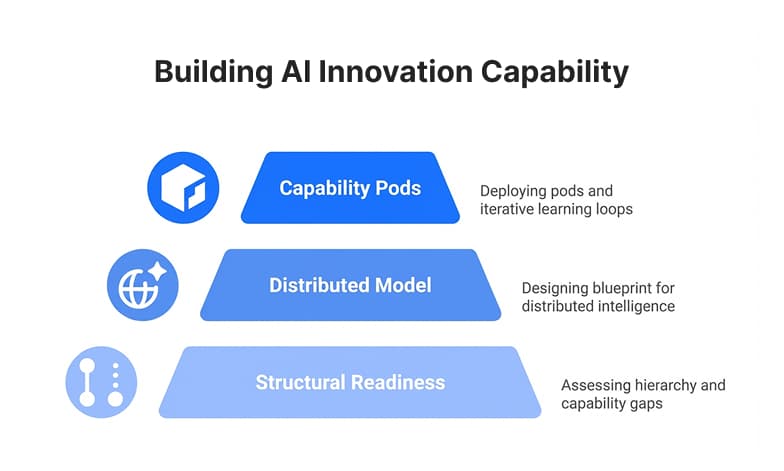
Phase One: Assessing Structural Readiness for AI-Native Innovation Capability
This phase identifies the architectural constraints that determine whether AI capability can scale.
- Where does hierarchy slow decision-making?
- Which capability gaps cannot be filled within current structures?
- What does siloed decision-making cost in innovation velocity?
AI centers fail when isolated from real operations or treated as cost centers. They succeed when embedded inside functional cores, tied to business outcomes, and focused on building proprietary capability where it creates strategic leverage.
Phase Two: Designing the Distributed Model
This phase entails designing the blueprint for distributed intelligence.
Choose geography strategically for talent density and AI-native skills. Define autonomy boundaries within unified governance frameworks.
This is Conway's Law in reverse: instead of structure dictating systems, enterprises architect structure for the AI-driven systems they need to build (Conway 1967).
Phase Three: Deploying Capability Pods and Iterative Learning Loops
This is where the architecture becomes operational.
Start with capability pods in high-impact domains. Embed Forward Deployment Engineers (FDEs) at functional cores where decisions, data, and business context converge. Every deployment compounds into the next, creating institutional knowledge that stays internal to the organization.
These are AI capability centers designed for distributed intelligence from inception.
Learn More: Owning Intelligence - The Case for Enterprise Sovereignty in the AI Era
Why Pakistan Is Emerging as the Frontier for AICCs
For decades, enterprises chose geographies for cost arbitrage. Pakistan represents something different: a demographic and structural convergence enabling AI capability centers to scale.
Pakistan is home to more than 300,000 IT professionals.
A population of 240 million with 60% under 30 creates talent density for AI-native teams (Government of Pakistan, 2024). Over 25,000 AI-native graduates enter the workforce annually, building capabilities from the ground up rather than unlearning legacy structures. (P@SHA, 2022)
Cost economics remain compelling at 33% of Indian rates and 70% below US equivalents (Samaa TV, 2025).
But the strategic advantage is structural. Pakistan's workforce approaches corporate innovation models with a leapfrog mentality, culturally aligned to building AI-first architectures rather than retrofitting old ones.
This is where AI capability centers become operational reality rather than boardroom theory.
Frameworks That Operationalize Sovereign Architecture
Diamond Team Structure (DTS)
CodeNinja's operational frameworks translate distributed architecture into compounding AI capability through three integrated layers of the Diamond Team Structure. It serves as the architectural blueprint for AI-native global capability centers.
.jpg&w=1920&q=75)
At the core, forward-deployed AI engineers embed within functional units, solving operational problems where business context lives. The middle layer positions solution architects translating business needs into scalable AI systems. The top layer features ML researchers, infrastructure designers, and domain experts steering long-term intelligence strategy.
This solves Conway's paradox: distributed structure producing coherent AI capability because skills progress upward through architectural ownership, ensuring knowledge grows institutionally, not individually (Conway 1967).
HYPER Infrastructure
Built from CodeNinja's experience of transforming traditional development cycles, HYPER provides the AI-native enablement layer. It enables enterprises to develop internal software rather than commissioning it from vendors.
It translates enterprise logic into scalable, production-grade systems, automating scaffolding, APIs, and integrations while keeping intelligence in-house.
AI-native workflows integrate from day one. Human-AI collaboration designs into team operating models. Data sovereignty builds into distributed architecture, ensuring intelligence remains proprietary.
Learn more: HYPER | CodeNinja’s Central Development Platform
How CodeNinja’s AICCs Redefine the Captive Center Model
The captive center model was built on a simple premise: replicate headquarters functions in lower-cost geographies to optimize operational efficiency. It worked for transactional work, but it fails for AI-native innovation.
Traditional captive centers inherited hierarchical structures, mirrored approval chains, and optimized for predictable execution. The metrics were cost per hour, headcount efficiency, and process standardization. Intelligence remained external. Capability never compounded.
CodeNinja's AI capability centers invert this logic entirely. Instead of replicating hierarchy, they architect distributed autonomy where Forward Deployment Engineers frame problems at functional cores. Instead of optimizing for cost, they build organizational capability that compounds with every deployment cycle. Instead of vendor-dependent intelligence that evaporates when contracts end, institutional knowledge accumulates internally.
The distinction is structural. Where captive centers treated geography as arbitrage, AI capability centers treat it as a talent strategy, accessing AI-native skills where they concentrate naturally.
Where traditional models measured efficiency through headcount, AI capability centers measure innovation velocity and proprietary intelligence generation.
This is building innovation capability through architecture designed for the AI era, where structure itself becomes a competitive advantage.
Learn More: Artificial Intelligence Capability Centers
From Theory to Dominance: Rebuilding Organizational Capability for the AI Century
Conway's Law reveals what becomes obvious only in retrospect: the problem was never just what enterprises chose to innovate. It was how they structured themselves to innovate continuously through AI capability that compounds.
Innovation sovereignty requires sovereign architecture powered by AI capability centers. Those who embed AI at functional cores, structure teams for continuous learning, and build intelligence they own will not just survive disruption. They will become the disruptors.
The blueprint exists. The geographies are emerging. The frameworks are proven. What remains is the organizational courage to stop renting intelligence and start owning it.
Ready to validate your AI sovereignty strategy?
Start with an 8-12 week pilot AI capability center. CodeNinja deploys targeted capability in one high-impact domain to prove feasibility, validate ROI, and design your long-term sovereignty blueprint.
Move from renting intelligence to owning it, one pilot at a time.
Bibliography
Conway, Melvin E. 1967. "Conway's Law." Accessed October 2025. http://www.melconway.com/Home/Conways_Law.html
Government of Pakistan, Press Information Department. 2024. "Message of Prime Minister Muhammad Shehbaz Sharif on World Population Day." Press release, July 11, 2024. https://pid.gov.pk/site/press_detail/25847.
Pakistan Software Houses Association for IT & ITES (P@SHA). 2022. "The Great Divide: The Industry-Academia Skills Gap Report 2022." Islamabad, Pakistan: P@SHA. https://www.pasha.org.pk/wp-content/uploads/The-Great-Divide-Industry-Academia-Skills-Gap-Analysis-Report-2022.pdf.
Samaa TV. 2025. "Pakistan Offers IT Services at 70% Lower Cost Compared to US." Samaa TV, 2025. https://www.samaa.tv/2087334239-pakistan-offers-it-services-at-70-lower-cost-compared-to-us.
FAQs
Q: How long does it take to establish an AI capability center that delivers measurable ROI?
A: Enterprises can validate AI capability center feasibility in 8-12 weeks through targeted pilot deployments in one high-impact domain. This proves ROI, validates structural readiness, and designs the long-term capability blueprint before full-scale investment.
Q: What metrics demonstrate whether an AI capability center is generating strategic value beyond cost savings?
Track the following:
- Innovation velocity (time from hypothesis to deployment)
- Institutional knowledge retention (models learning organizational context)
- Proprietary intelligence generation (capabilities competitors cannot replicate)
- Successful centers shift from measuring efficiency to measuring compounding advantage.
Q: How do enterprises mitigate risks when transitioning from vendor-dependent AI to internal capability centers?
Deploy hybrid models initially, meaning maintain vendor relationships for non-core functions while building proprietary capabilities in high-impact domains.
Pilot deployments validate feasibility before full transition, reducing risk while accelerating internal learning cycles and knowledge retention.
Learn More: Beyond the Pyramid: AI Innovation Sovereignty and the End of Consulting Dependence
Q: How should enterprises handle data sovereignty and IP protection in distributed AI capability centers?
Embed data governance into distributed architecture from inception through encrypted data pipelines, geo-fenced storage, and role-based access controls.
CodeNinja’s framework embeds compliance standards across geographies, ensuring proprietary intelligence remains secured within enterprise boundaries regardless of team location.
Learn More: The Great Insourcing: Why Enterprises Are Building What They Used to Rent
Q: When should enterprises prioritize building AI capabilities internally versus continuing with external vendors?
When vendor dependencies slow strategic decision-making, when AI investments fail to generate institutional knowledge, or when competitive differentiation requires proprietary intelligence.
An 8-12 week pilot validates readiness by proving ROI in one high-impact domain before enterprise-wide deployment.
Learn More: AICC Engagement Models
