Physical AI for Logistics: Reclaim Your Margin with Intelligence That Reasons
Deploy computer vision trained on facility physics. Eliminate damage disputes, stop cargo theft, automate ESG compliance—without replacing infrastructure.


The logistics industry has crossed a decisive divide. McKinsey’s 2026 Global Tech Agenda confirms that AI pioneers are now outperforming laggards by 4 percentage points in EBIT margins. For operations running on razor-thin spreads, dock-level "invisibility" is no longer an inconvenience but rather a compounding financial crisis.
The Failure of Passive Systems
Traditional infrastructure is designed to record, not to reason. When a pallet arrives light, a seal is compromised, or a high-value component is "skimmed," your current systems fail you:
- Cameras record the loss, but offer no real-time verdict.
- Systems log the transaction, but lack the physical context.
- The Result: You are left with evidence of a loss, but no accountability.
The Compounding Cost of Invisibility
This "Visibility Gap" manifests as three critical threats to mid-market viability:
- The Financial Leak: 3–5% of Gross Revenue lost to "Invisibility Taxes" and value leakage (PwC 2026).
- The Security Surge: 60% Surge in Cargo Theft during 2025, driven by sophisticated skimming networks.
- The Regulatory Wall: Scope 3 Mandates (California SB 253) requiring audit-ready logs by 2027.
At CodeNinja, we deploy Physical AI—an execution layer that activates the latent intelligence in your existing camera infrastructure. By training models on facility-specific dock physics and specialized tampering signatures, we move beyond passive surveillance.
The result: Cameras that generate verdicts, not just evidence.
.webp&w=2048&q=75)
Operational Constraints Creating Visibility Gap
Dock Operations
- 330–50 admin hours weekly that's 80% redundant but legally necessary
- Dispute resolution in days; customers repeat accounts
- Footage provides recordings not reasoning; cannot prove moment seal compromised or pallet skimmed
Operational Scale
- Scope 3 requires shipment-level data; fleet averages don't satisfy SB 253 or enterprise clients
- Audit readiness constructed retroactively, not embedded as workflow byproduct
- Visual evidence lacks temporal context to prove when, how, or whose watch
Compliance & Risk
- Cargo theft detected after loss; networks operate at machine speed vs. human defense
- 20% volume growth requires proportional headcount; scaling intelligence means replacing infrastructure
- Growth breaks volume-margin link; manual verification caps profitable expansion

Layer 1: Edge Processing & Model Intelligence
- Zero-Disruption Integration: Connects via RTSP/ONVIF—no new cabling or camera replacement required.
- Process Reward Modeling (PRM): Our Knowledge Teams reward models at each reasoning step, ensuring the AI understands causation, not just correlation.
- Temporal Logic: Evaluates event chains (e.g., Identifying a seal was intact at 04:00 and compromised at 04:15 during a shift change).
- Adversarial Validation: Double-blind evaluations ensure 99%+ accuracy that stands up to insurance and legal scrutiny.

Layer 2: Operational Integration & Sovereign Intelligence
- Visual Receipt Generator: Auto-files timestamped documentation directly to the WMS.
- MCP-Enabled Connectors: Bidirectional WMS/TMS integration ensures no parallel data systems or manual re-entry.
- Total Sovereignty: All fine-tuned models and Golden Path datasets transfer to the operator at completion zero vendor dependency.
Use Case of Physical AI for Production Operations
- Visual Receipt & Dispute Velocity
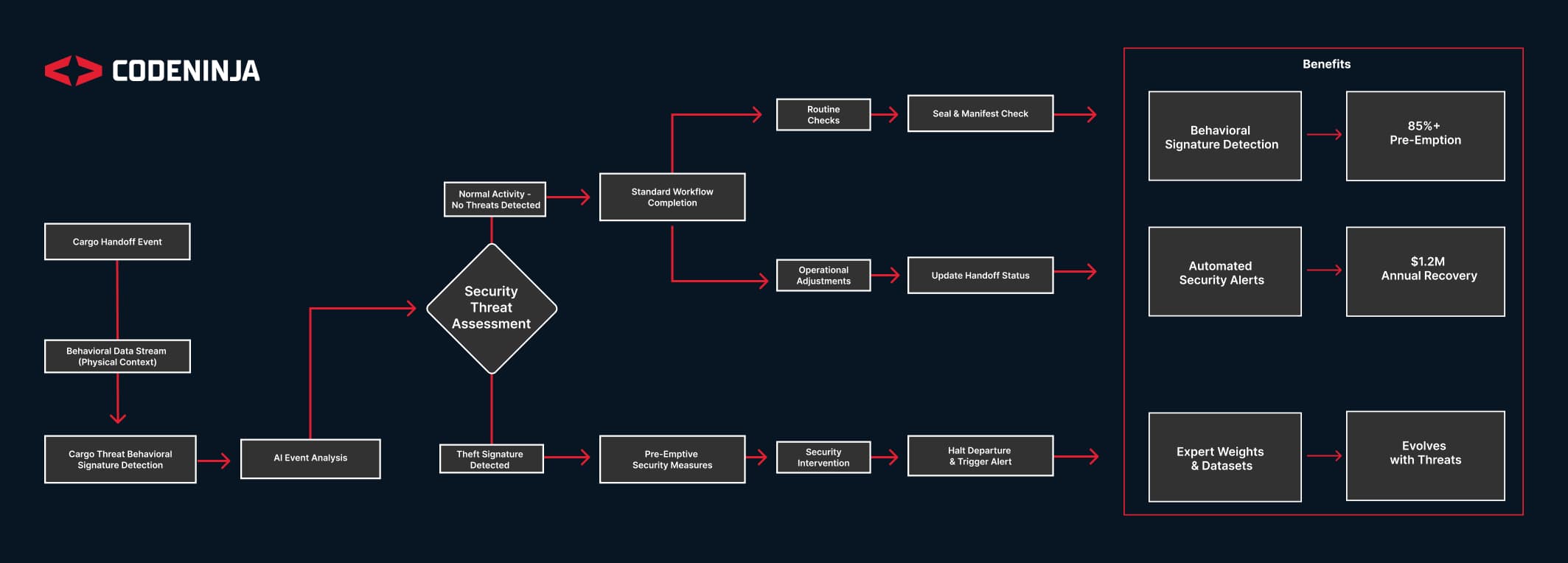
- Cargo Threat & Theft Pre-Emption
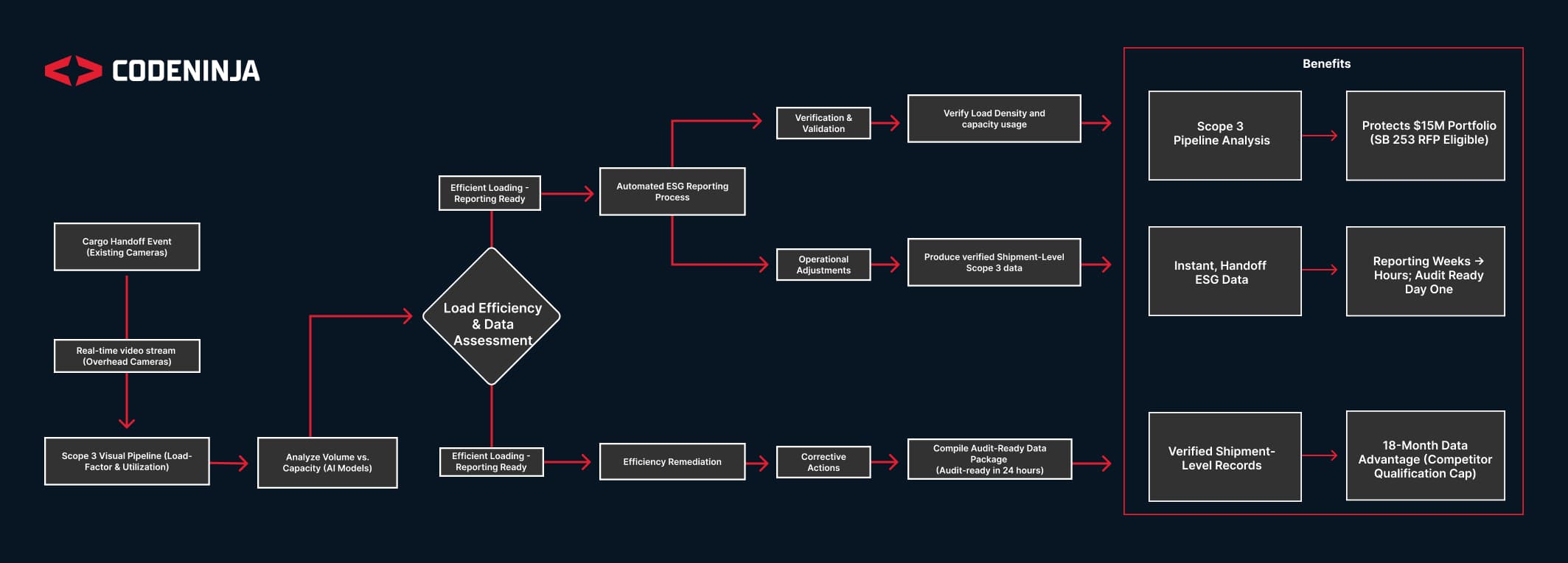
- Scope 3 & ESG Contract Retention
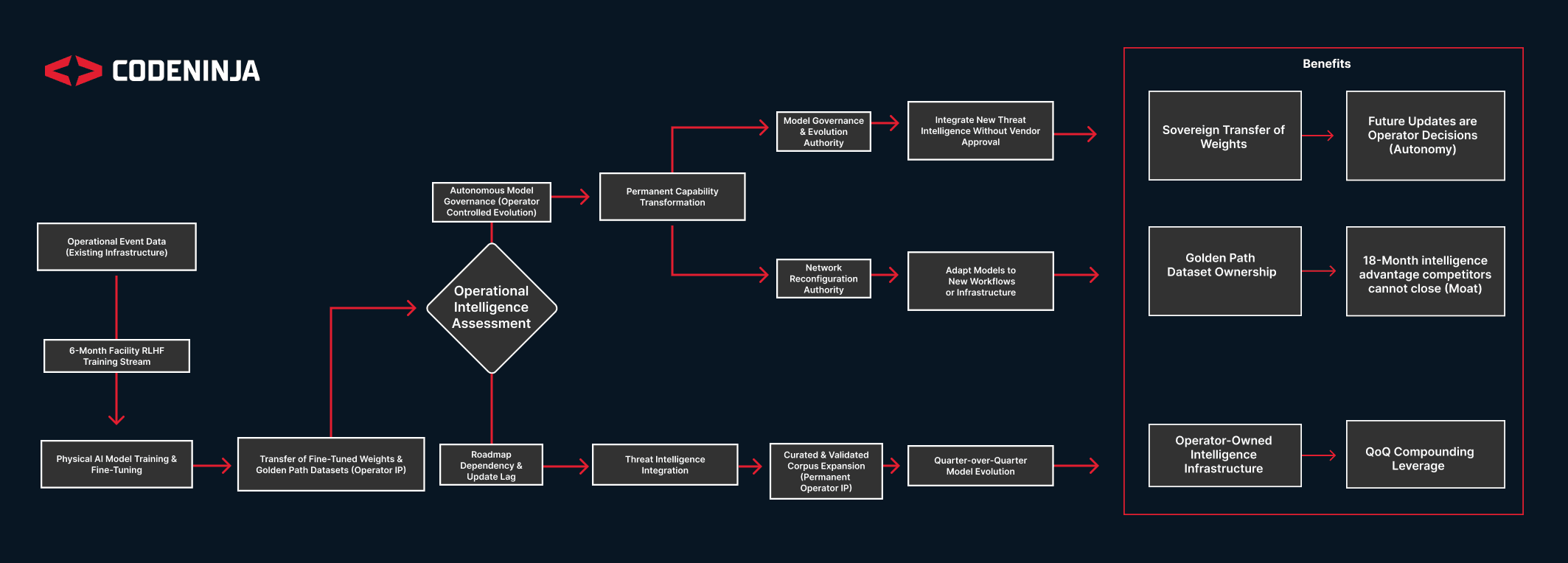
- Sovereign Weights & Independence
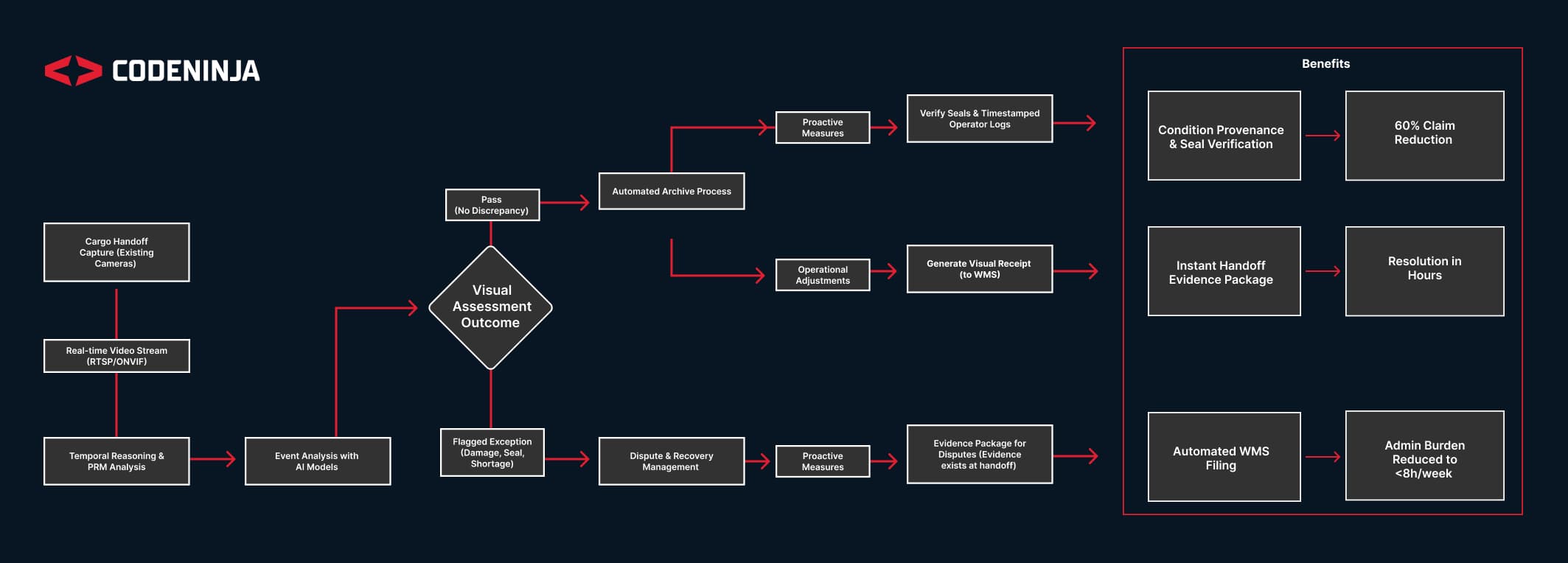
Visual Receipt & Dispute Velocity
The Problem: Manual Photo-Matching Trap
Mid-scale 3PLs absorb 30–50 hours weekly on manual damage photo-matching. When disputes arrive, staff locate footage, timestamp frames, cross-reference reports, produce packages that may not satisfy insurers. Process is 80% redundant but 100% legally necessary. Resolution takes 3–7 days. Signals opacity, not accountability.
The Solution: Automated Visual Receipt Pipeline
Visual Receipt Generator deploys at every handoff. Generates timestamped captures, condition classification, seal status, operator logs. Auto-filed to WMS. The 30–50 hour burden drops to under 8. Evidence exists at handoff, not constructed retroactively.
The Result
- Velocity: Resolution reduced 3–7 days to 4–8 hours
- Recovery: 60% reduction in claim payouts via instant proof
- Compliance: Audit trails as workflow byproduct
Frequently Asked Questions
